Category: Writings

  • Those Statues

    Those Statues

    Those statues,
    Lingering, though we no longer gaze upon them with reverence. They lumber now, as cruel imaginations arising from our past. Always finding in them the chemical of bile, foaming up through their mouth or their fingernails or their eyes. I feel that same texture trailing gravity down my skin, just another shade. Turning to glance at the drab illusion we’ve so dreadfully conjured over the same dead horses we’re still beating, haunting this cosmic gimmick. The swing of my baseball bat indirectly channeled through six distinct corporations so that it’s justifiable under the moral law of distance1, a law I just made up right now. Those statues still taunt us—despair of hopelessness—we are who we were. Doomed to the moral atrocity, a generational gap until we’re these statues glaring down, casting the next foreshadow of cognitive dissonance.

    How few gleam hope from the foreshadow?

    Humanity falters through the door of compromise, stumbling as a drunk. One laughs at their neighbor’s folly while likewise tumbling through another door leading into The same room.2 We continually construct doors fitted with our personal aesthetics, as if entering a room from a different point on The wall changes The room itself.

    This is modern morality in practice:
    A longer argument – same conclusion,
    An aesthetic,

    Which even in its appearance, lacks consistency. For the drunk not only inhibits their reason, but also their presentation of that “reason”. This clear inconsistency scampers beyond critique’s grasp though. Not through clever deceit, but rather an obsession with The wall. Everyone is intoxicated, inhaling the fumes of moral high ground through proclamations of judgment against those who lived seven generations ago. Rather than learning from these past moral blind spots we act like we’ve achieved the godhead; judging history with moral clarity while wasted in the alleyway. Vision blurring the dumpsters into divine instruments of righteousness, golden chariots to be ridden to manifest destiny – transcendence. No fear before our eyes, a psychotic certainty that we will never be that generation ourselves. Judging the past, hoping society runs out of meeting minutes before confronting our present age.

    Regardless, what lingers to be analyzed when we all stagger into The same resultant? “That puzzling piece has been bashed into place with a hammer.” A possibility so alien, it feels like divine revelation. From every viewpoint we are the fool, etching across The wall—humankind’s catastrophe. At least our ancestors used a cave wall3—natural catastrophe.

    A door frame with blood applied is equivalent to the Egyptian’s door if they both go down into The Red Sea after the Christian made God a man, sin as part4. The believer drags God down into The room with an audacious claim, “My interpretation regarding divine revelation’s text is at least remotely representative of God’s morality.” How does a sinner part The Red Sea? This delirium brought into focus by the thousands of Christendom’s denominations and those millions more fictions within those denominations. Moral objectivity achieved by translating God’s breath thrice. The Christian nationalist declares empathy a sin5 while the progressive Christian cherishes it, both conclusions from the same text. An individual interpretation warped into an individual worldview.

    Both however find themselves as Pharisees, just one more hypocritical than the other. If God indwelling humanity wields the hatchet taken to the neighbor’s door or fails to prevent another believer from wielding it, The resultant is equivalent.

    How does God living inside people fail to divinely transform them? The Christian walk is paced with no supernatural step when compared to an atheist’s path. Both equal ability to live out Christ’s Sermon on the Mount. Why walk through the Door when he leads to The room?6 Their gospel proclamation even more pitiful when the God living inside tells them immoral pieces of The room are not only morally justifiable, but righteousness itself.

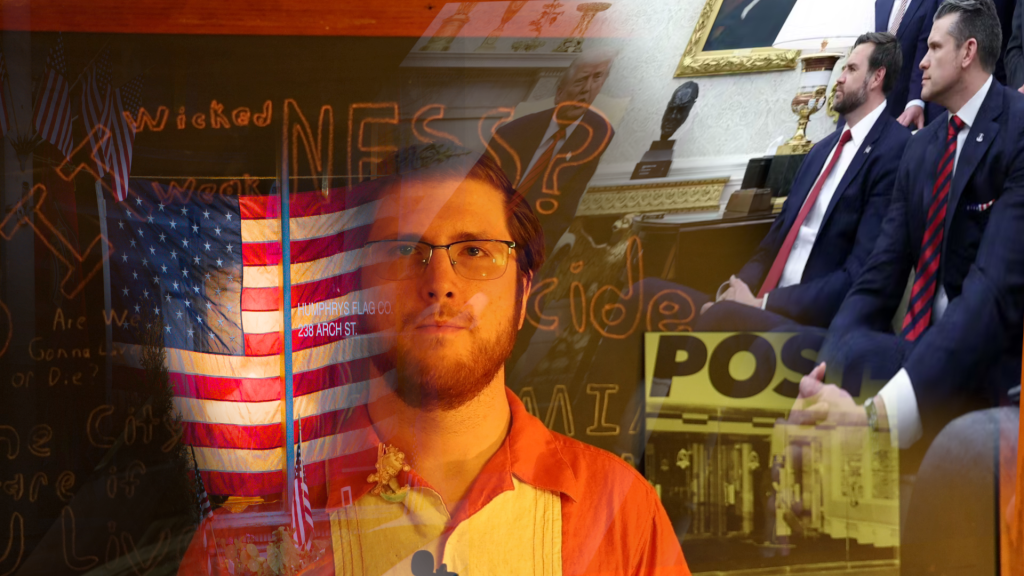
    This is an obvious observation, even the religious understand, “Religion makes morally normal people say and do disgusting and wicked things”.7 The Christian mandates in response, “It is Christ you need, not a religion.” I inspect the morality of these Christians through the rise of the German Reich. Blaming an ethnic group for the cross was their forerunner8, carving for them the antisemitism which still festers among the most disgraceful of society. The evangelical today clarifies from the pulpit, privileged through robbery of those they duped, “It is Christ you need, organized religion is birthed of Satan.” Yet they find their inspiration from these same moral Satanists, forsaking Jesus Christ of Nazareth: Nick Fuentes, Steve Bannon, Candace Owens, Tucker Carlson, Elon Musk, Donald Trump9; the new Christs of the church, but Antichrists in their very actions.

    Most Christians clarify upon this initial clarification, “the evangelical is a blasphemer, we don’t hold the evangelical’s unforgivable views.” But if God in Humanity can’t even withhold the Antichrist within Christendom, let alone the world, then god is as morally pathetic as the Christians who lay claim to his kingdom. If the God living inside the “true” Christian (I was one of those hypocrites) cannot empower them to successfully fight such blasphemy, turning the world into the judgment of hell itself (or at least speak against it) then their “true” god is just as much a false idol.

    Thereby we find ourselves retracing with horrifying precision those foreshadows again. Evangelical Christianity laying the moral justification for evil which leaves us in belief–not in God, but that we must be demons ourselves. How can humanity commit with our hands the Lake of Fire on earth and call it righteousness? The morally progressive christians useless, as they fail to shame out of existence the evangelical. Their worthless god without resistance reduced to a dildo by the evangelical, achieving for them cultic orgasms, attempting to usher in the mother ship carrying Jesus Christ returning for their vile frame. They care not about the practical harm their beliefs cast upon humanity, but find all their pleasure in the sufferings of others by viewing that inflicted pain as a self-fulfilling “end times prophecy.” Evangelical Christianity is allowed to exist as a perverted fetish. A worse blasphemy than Piss Christ, for they have debased Christ to the urine itself. The other christians just stand around on the sidelines, mouth breathing into eternity with a hopeful delusion for a new world since they’ve so pathetically conceded this one to the Antichrist. Moral Antichrist or moral passivist, it all leads to The room.

    What’s the atheist’s excuse then? We make the assumption that pressing past dogma should give transcendent clarity. Even if that leap of an assumption is correct, the point is irrelevant in relation to our moral progress. As was established, moral progress is not gained by assessing other’s moral depravity. It is rather obtained by painstakingly assessing our own –

    My own.

    This lack of self-examination is the reason these seemingly contradictory moral proclamations lead to The room. We lack the conviction religious apostles die for, to defend principles we don’t even actually have. I take one position to justify complacency in another, but even within that position I live short of the proclamation that my moral stance should be principle, stumbling through another door upon that same wall—mouth breathing with complacency, just as the religious I critique.

    I accept falling short of becoming a revolutionary because being a leftist in ideology is better than being fascist, failing to recognize lacking moral dogmatism allows Christian nationalists to take power right under the “surveying” nose of reason. Even observing our present state, Stephen Miller is Chief of Staff, believing the White House is named so because it’s meant for only white men to inhabit. How does it feel to forsake science by throwing the entire trans community under the bus and still lose to people who think the earth is literally 6000 years old? Capitulation is the moral coward’s door, but that door becomes utter insanity when capitulation doesn’t even bring small victories, let alone another room. The scientists capitulate again, the intellectuals sit in silence, the masses are hypnotized into normalized government executions and abductions, and I live as if my moral principles are personal preferences. The problem is clear, Christian nationalists do not live as if their moral principles are moral preferences and they are certainly not silent. Now the morally inconceivable is divine command—not in theory—but in practice.

    America, just as Germany was before it murdered 6 million Jews and began that horrid, self-fulfilling “end times prophecy” is the morally progressive nation. One of science, technology, culture, philosophy, art, and all the other values which we crown as jewels for a society. Yet we again capitulate society to the moral drunkard through our own moral complacency and it doing so we become moral drunkards ourselves. We say compromising our values and principles is not only okay, but the moral decision itself because it might give us short term political benefit. When you run on Donald Trump’s first term border policy to win a single election it justifies his second term’s “final solution”, because that “final solution” seems no longer radical, but necessary.

    This Overton Window now casts through its lens the foreshadow from statues of Nazi leaders. We look upon those statues as they ooze hellfire through their very pores. Disgusted, while we craft the same bile within The room. It just doesn’t appear as repulsive from our near perspective. One could even drink this delectable bile while singing praise, “Oh foreshadow, let us repeat our repetitive cycle of hell on earth!”

    Knights of Reason

    If a knight of faithful delusion can move mountains into the flames of hell, conceptualize then what ranges an army knighted by impulsive-reason10 could move into paradise! To choose another wall rather than a door upon this crumbling wall is an expedition upon a new founding for humanity. Fervor and conviction, oh zealot of reason teach us impulse!

    The time has come to forsake the moral high ground of hypocrisy within The room and enter with surety through another door upon a new wall. To press forward with a sober and clear mind, knighted as a zealot of impulsive-reason. Equip with the confidence of a religious fundamentalist, one born again into eternal life—not of the self—for humanity itself.

    We cannot afford to be unsure when those “enemies within”11 are so very very sure.

    We have learnt, rather too late, that action comes, not from thought, but from a readiness for responsibility. For you thought and action will enter on a new relationship; your thinking will be confined to your responsibilities in action. With us thought was often the luxury of the onlooker; with you it will be entirely subordinated to action. ‘Not every one who says to me, “Lord, Lord”, shall enter the kingdom of heaven, but he who does the will of my Father who is in heaven’, said Jesus (Matt. 7.21).

    Dietrich Bonhoeffer from a Nazi prison in May of 1944 12
    References
    1. Colin McGinn, “Moral Distance,” Colin McGinn – (blog), January 5, 2019. ↩︎
    2. Matthew 7:5 ↩︎
    3. Plato, The Republic – Book VII ↩︎
    4. Philippians 3:6-8 ↩︎
    5. Albert Mohler, Joe Rigney, “The Sin of Empathy,” February 19, 2025. ↩︎
    6. John 10:9 ↩︎
    7. Christopher Hitchens, Harold Kushner, Peter Gomes Debate 2009 – Timestamp 1:17:27 ↩︎
    8. Matthew 3:1-3 ↩︎
    9. Man Prays to Donald Trump Before Being Arrested ↩︎
    10. Humanity Itself ↩︎
    11. Donald Trump, “‘The enemy within’ should be handled by the military,” October 14, 2024. ↩︎
    12. Dietrich Bonhoeffer, Eberhard Bethge, and Reginald Horace Fuller, Letters and Papers From Prison. The Enlarged Edition. 1971. – Section: Thoughts on the Day of the Baptism of Dietrich Bethge ↩︎

  • To Provoke Your State

    To Provoke Your State

    This staircase, it leads only to
    Some old pictures of you
    Through an a thousand mile long tube

    Black Country, New Road – Concorde

    The orator no longer need stand, huddled by masses for declaration.
    The author, free from the printing press’s oppression.
    The artist, no longer bound by the material limitations of space.

    How incredibly horrifying / wondrous!

    I can provoke your emotional state using agreed upon symbols running “through an a thousand mile long tube.” What responsibility! Either laugh at Charlie Kirk’s death / Or calmly explain the implications of political violence and practical harms of right-wing politics1. Either / Or2, it doesn’t really matter. You’ll tell me I deserve death regardless while either reciting jumbled talking points from a YouTube grifter3 / Or a Twitch streamer who read half of The Communist Manifesto before ADHD forced their return to TikTok.

    I can provoke your rational state using vocal utterances bouncing hollowly between the cave walls within your echo chamber. Either tell you Jewish space lasers caused a series of wildfires4, sourced from my personal opinion of how wildfires spread and an antisemitic worldview / Or that heating our planet with fossil fuels is bad, sourced from peer-reviewed academic papers5. Either / Or, it doesn’t really matter. We’re all lunatics lighting ourselves on fire with torches cast in midday sun6. It’s not like we even notice though. Either you’re unhealthily obsessed with one random guy exploiting a welfare program to notice Peter Thiel pouring gasoline onto your already enlightened head / Or burning yourself alive is in fashion now, it can’t be harmful if we’re all doing it.

    To expound upon that sickening amalgamation festering between our neurons would in all likelihood provoke the few brain cells left within my skull’s containment to disappear in shame for who we are. The potential of our connected globe, yet we stumble continually through a revolving door of either Andrew Tate / Or Vaush. Insisting that there exist only two choices for building a fantasy world balanced on delusion. Repetition of the declarative statement, “humanity cannot think for itself.” Therefore, we must happily sip idiocy, rather than provoke our own mindful state. Either laughing with glee at suffering / Or bored out of our mind at the brain rot we’re ingesting. Either way, it doesn’t matter because we’re all collectively chanting with a deranged gleam in our eye, “Let those whose bile we consume, consume us.”

    There sits endless space – Our obligation to take voice, pen, and brush to it. The only means by which to defy slop is to confound it with art. There is a possibility that truth continually lies, obscured under this stupor of idiocy. But if there exists only idiocy, then one might rightfully conclude that only idiots exist and surrender to becoming an idiot themself, for we are social creatures. To idle among the void-sized hole AI’s bile has formed is to surrender humanity to a tech billionaire. To an oligarch proclaiming before your face through action that he doesn’t believe in your right to existence.

    In some sense, “Boredom is the root of all evil.”7 Not because boredom provokes oneself to engage with irrational activity, but rather because its passivity allows boredom’s default production of uninspired product to be assimilated into the bile by those with goals less than humanity’s enrichment through art and reason.

    References:

    1. Three Arrows. “The Myth of Charlie Kirk,” October 12, 2025. https://www.youtube.com/watch?v=Kh0el8phS_o. ↩︎
    2. Søren Kierkegaard, The Essential Kierkegaard, Princeton University Press, 2000, p. 43-46. (Either / Or An Ecstatic Discourse) ↩︎
    3. Shoe0nHead, “These People Are Sick,” September 18, 2025, https://www.youtube.com/watch?v=eJENP0Rr8p0. ↩︎
    4. Justin Gray, “MTG Says the Deadly California Wildfires May Have Been Caused by Lasers From Space,” X, January 28, 2021, accessed December 21, 2025, https://x.com/JustinGrayWSB/status/1354870334655262724. ↩︎
    5. hbomberguy, “Climate Denial: A Measured Response,” May 31, 2019, https://www.youtube.com/watch?v=RLqXkYrdmjY. ↩︎
    6. Friedrich Nietzsche, Nietzsche: The Gay Science, Cambridge University Press, 2001, 125. ↩︎
    7. Kierkegaard, Søren. The Essential Kierkegaard, 2000, p. 51. ↩︎

  • Humanity Itself

    Humanity Itself

    Body, soul, mind: To the body belongs sensations, to the soul impulses, to the mind principles.1

    Marcus Aurelius, Meditations

    Remember,

    You can not expect all humanity to see reason as apparent. We are so shortly removed from our enlightenment that we must still gather together these principles which govern our reason.

    We desire activity.
    We desire leisure.
    We desire food.
    We desire sex.
    We desire procreation.
    We desire companionship.
    We desire community.
    We desire domination.
    We desire compassion.

    All these desires – impulses, not gathered carefully in reason’s care, rather evolved through selection pressures fitted to survival. Therefore, to give into this desire without first committing to reason is to deny humanity’s Enlightenment through reason.

    This is not to say that impulse acted on through desire for bodily sensation is of itself uniquely evil. Repression is to deny your humanity – to betray your own soul. For humanity is not segregated to reason, we are still who we are. Casting away 4 billion years of life’s evolution2 would be rather deranged. Impulse has driven us to new frontiers, to the craters and mountains upon our lone satellite. Desire will drive us farther still to new expanses beyond our current comprehension. Impulse blessed us with art, with love, with sacrifice, with glory. Without impulse, we would utterly lack that which makes us so strangely and uniquely human. One should not allow the chemicals in their brain to govern their actions. For we observe the natural consequence wrought through blind impulse, the horrors consuming as a fire unfought our so pragmatically constructed institutions. But reason tooled as a conqueror shall utterly repress the impulsive drive of desire and stamp out our dying light, casting us into the eternal night.

    Let others complain that the times are evil. I complain that they are wretched, for they are without passion.3

    Søren Kierkegaard, Either/Or

    I see in the light a transcendent humanity.
    One –
    Glorious collective, jointed together in our individuality.
    To transcend – stabbing into what we feared was eternal night,

    A NEW DAWN

    One –
    By which we cast off the pettiness etching such violent dispersions through our minds. To see clearly in each other’s eye the clarity of this opportunity before us. My own small part brought into focus through the endless reflection from your collective eye,

    A NEW RENAISSANCE ENLIGHTENED –

    By impulsive-reason.
    Though abandoned by our every God, thrown without mercy into the chaotic void. Or perhaps more terrifyingly by means of our ignorance,

    …we have killed him! How can we console ourselves, the murderers of all murderers! The holiest and the mightiest thing the world has ever possessed has bled to death under our knives: who will wipe this blood from us? With what water could we clean ourselves? What festivals of atonement, what holy games will we have to invent for ourselves? Is the magnitude of this deed not too great for us? Do we not ourselves have to become gods merely to appear worthy of it?4

    Friedrich Nietzsche, The Gay Science

    Let us then gather our bearings so that we may find ourselves worthy. For the swords shall be beaten still to plowshares!5 Preach this gospel of true hope! Is it not the conditions which regard our swords as worthless, not God directly?6 This now our great responsibility! There is no God nor cosmic force willing to bend our weapons for us, to redeem us from needless annihilation. We must bear the responsibility – equipping the hammer, lighting the flame, and standing before the anvil. Not to contort our swords, rather by the labor of our souls upon the anvil of progress forging the obvious choice for our next generation.

    Humanity, the closest force to God we now know. Therefore, our duty must be that which necessitates the burdens of our universe and nature itself. The terrifying and yet joyous truth, we are so pitifully far from deity – wonderfully and fearfully Humanity!7 A humanity which birthed God in the clarity of impulse and through deluded reason murdered him! A Humanity which must embrace this universal chaos through transcendence. Transcendence, not to ascend our Humanity, rather to faithfully clasp to it in the light of impulsive-reason. That we might with accuracy interpret our bodily senses amidst these chaotic seas. Before us the task assigned to the Gods, We are to face Leviathan – utterly alone. Just as our ancestors, only now not deceived into believing We are aided in this endeavor. Our only force, what We muster for battle from our globe of priceless treasures, not of gold, rather the pearl of Enlightened flesh and blood8 – Humanity itself Renaissanced.

    For he who values his own intelligence and the divinity within him and the worship of his excellence before all else, plays no tragic part, does not groan, does not need either solitude or much company.9

    Marcus Aurelius, Meditations

    References

    1. Marcus Aurelius, Justin Martyr, Walter Pater, and Irwin Edman, Marcus Aurelius and His Times : The Transition From Paganism to Christianity, print (Walter J. Black, INC, 1945), 32. ↩︎
    2. Bell, Elizabeth A., Patrick Boehnke, T. Mark Harrison, and Wendy L. Mao. “Potentially Biogenic Carbon Preserved in a 4.1 Billion-year-old Zircon.” Proceedings of the National Academy of Sciences 112, no. 47 (October 19, 2015): 14518–21. https://doi.org/10.1073/pnas.1517557112. ↩︎
    3. Søren Kierkegaard, The Essential Kierkegaard (Princeton University Press, 2000), 40. ↩︎
    4. Friedrich Nietzsche, Josefine Nauckhoff, and Adrian Del Caro, Friedrich Nietzsche: The Gay Science, pdf (Cambridge University Press, 2001), 120. ↩︎
    5. Isaiah 2:4 (NRSVUE) ↩︎
    6. Isaiah 2:3 ↩︎
    7. Psalm 139:14 ↩︎
    8. Matthew 13:45,46 ↩︎
    9. Aurelius, Martyr, Pater, and Edman, Marcus Aurelius and His Times : The Transition From Paganism to Christianity, 29. ↩︎

  • Make Art

    Make Art

    Sometimes I feel like maybe I go easy on art (film, music, etc) and I like a lot of stuff that’s maybe not as respected
    Anyone relate?
    Most recent example is I’ve been really vibin with the new Lil Tecca album and I was surprised to learn this thing isn’t liked.

    A friend of mine brought up this question in a Discord server. It prompted some initial thoughts which I added to the discussion, but it brought me to farther contemplate the question. The ramblings in this essay are a result of those thoughts.

    I often find myself enjoying art that technically isn’t masterful, maybe it could even be classed as objectively bad. That fact often battles with my desire for harsh critique, it makes me feel like I don’t respect the arts properly. How do I enjoy art if critics I respect say it’s bad while giving sound reasoning for it being a poor quality work? If I’m being objective I often find plenty to critique with these pieces myself, but I still enjoy them. Does that make my tastes bad? Perhaps. Why do I care so much though? What’s the worst that could happen? I get judged for not understanding the arts, for having bad taste? So what! Don’t we despise the critics anyway? Society gets a vast array of issues wrong that should be objective with basic reasoning yet we assume it to be correct when entertaining matters of taste.

    That is not to say critique should be cast away. Quality critique accepted by an artist properly empowers one to more effectively express themselves. But critique can also make us question our own tastes rather than just letting them develop through natural experience.
    I’ve been trying hard to shift my perspective because of this side effect critique has upon individuals and society as a whole. It’s left me with a goal to bring my mentality to:

    If I like art, I should like it.
    If you like art, like it.

    Yes, we should respect the technical aspects of “good” art made through a clear understanding of technique and the history of the medium(s) being explored. That should not however stop us from enjoying abstract art that had no thought go into it (at first glance at least) or using our time on movies with a poor understanding of filmmaking. Those works are also art and we can still take away from them as humans even if just our most primal response of “I enjoy that” or the use of critical thinking to understand why we don’t like an idea that an artist presented to us.

    Treasure the masterful works of a Beethoven but don’t let that stop you from saving room for ice cream with Lil Tecca. Good taste doesn’t come from enjoying a book you’re reading to then abandon it because a critic you respect didn’t like it. Good taste that is true to yourself comes from a meaningful exploration of the arts. There’s a reason your tastes have changed from your childhood to your teenage years through to being an adult. What you enjoy will continue to change by means of experiencing life. Living is the most genuine way to refine our tastes. To suffer our most violent pain and to take in a breath of fresh air during our most serene moment. Living leads us to understand in greater depths ourselves, thereby the human experience and in turn humanity’s creations.

    Critique culture also makes us fearful (at least it does for me) of making art, especially if one considers themselves a “hobbyist”. The trap we fall into is the assumption that if art isn’t “good” through the lens of those analyzing, it holds no value. Whether that audience be a friend, yourself, or thousands viewing it through a series of tubes that audience can be crippling.

    I’ve been slowly realizing how flawed that perspective of fear is since I started my journey in photography. Some of that intimidation comes from the commodification and as a result the commercialization of art. Money has warped and mangled our brains so morbidly that everything including art has a value that finds its definition in what someone is willing to pay for it to be their property. Social media has twisted the wiring within our brains into an even more disfigured abomination. Money can at least buy us things, a like on Instagram gives us a cheap dopamine hit. This problem is made even worse with money now being tied to social media, we can now monetize views and likes directly and indirectly. Don’t get me wrong there’s a lot of positives to artists being able to make a living just by sharing their work, but we are often unable to separate success from the worthiness and actual value of art. Artists who are producing valuable art can feel their work is valueless when in actuality that feeling comes from not obtaining engagement through a biased algorithm.

    None of this should be surprising, we know what happens when we tie money and fame to art, the horrors are right before our eyes. Art becomes a means to money rather than a way to engage with our soul or maybe just simply be an end itself. Even if the artist(s) are still passionate about what they’re creating the work will always be tainted by the underlying plague of capitalism. The value of art is no longer its commentary, the raw emotion it pulls from our inner being, the change it affects on society, its challenge to our worldview, expansion of our narrow mind, or ability to understand our thoughts. No, it’s the amount of money the movie made at the box office, the number of awards an artist’s discography has for sales numbers, the YouTube placard hanging in the background of your favorite content creator, or amount of likes art gets on the internet. Money and notoriety shouldn’t even be a factor when judging art’s value, but it has become the greatest factor. How could it not? Society revolves around money. I’m not even trying to make artists feel guilty. Everyone has to make a living and just staying alive is immorally expensive right now. Why do we act so shocked then when artists completely sell out for money? When they reduce themselves to doing commercials for the corporations they know are actively murdering us? Many of them started like every American not born with a silver spoon in their mouth, just trying to survive. As it turns out, often the only practical way to survive is to capitulate one’s morality, what else can someone do? The problem is that this participation normalizes and validates our current social structure and the money one is given farther numbs one’s moral compass. What we viewed as so destructive is now normal, it’s the way things are and they aren’t going to change so might as well make some money while I have the chance.

    This leads us to a farther haunting conclusion. If art, and really anything we produce is defined through its monetary success and popularity, how do we as a society define you? Is your worth really that of your income? Is it how productive you are at your job? Of course we know that’s ridiculous, but that’s the way society functions. That’s how capitalism defines your value. Why do we conform to this? We allow billionaires to disparage us with their actions and words. They don’t even take the conservative approach of telling us the hours of work at a job we hate isn’t “working hard enough.” Work doesn’t even define you to the billionaire, rather it’s the amount of money that work makes. Because enough of us fall for their lies they get away with claiming they don’t oppress us with their wealth hoarding and make laws that actively murder the lower class through lobbyists. They should all be in jail just from the damage they’ve done by claiming you’re worthless. That you’re lazy scum they have the right to wipe off the bottom of their corporate shoes after you’ve served your purpose to them.

    You have value and that value is not defined by the money you make, your social media likes, or even your productivity. If you are not in the process of murdering, oppressing, and exploiting millions of Americans and billions more around the world then you already have more value than any billionaire. The fact you’re not purposely harming others is plenty to validate your existence. Don’t let anyone disparage you from your attempts to improve your life and the lives of others. You’re capable of expressing your value to greater extents than the narrow box society places you in.

    I would like to finalize this essay by affirming one medium of expressing your value, the one this essay is really about. Your art has value because it meant something for you to create it, that’s all the value and validation it needs as an excuse to exist. If someone else likes it, that’s a cherry on top. Make art and share it, it doesn’t matter if people don’t like it. It’s good because you had an experience making it as a human with intrinsic value. And who knows, the critique and praise resulting from your own effort could be far more revolutionary to your life and our world than you ever thought possible. You are valuable, therefore what you create must contain some of that value intrinsic to you. Making art is to defy the very value system they inflict upon you, to clearly display their lies for everyone to see, to acknowledge for yourself that you’re not worthless!

  • Choices Ring

     “To be, or not to be” –
    From Hamlet ring to thee –
    In Pilate’s hall was queued
    With Christ, “what shall I do” –

    “I have a dream” was cried –
    With passion from the heart –
    Off from script King leapt –
    Choice – to shake the earth –

    Ferdinand one turn of car –
    A turn that charged him death –
    As well sprung forth a world at war –
    And placed the earth in doom –

    As wind that blew by August sixth –
    Carried – careful clouds –
    From Kokura changed the flash –
    Forever lives were shook –

    One may not seem substantial –
    As Pilate judge of each –
    Or wise as King’s defining words –
    Nor powerful as nukes –

    But each “to be” or choice –
    Binary they may seem –
    As wind and turning car –
    Could be the world to all –